|
|
|
Sun, Sep 30, 2007
|
Ukraine 2007 parliamentary election
|
 Voters in Ukraine also went to the polls today. Ukraine holds an early parliamentary election, at Global Economy Matters, has partial 2007 election results and reviews the electoral system and post-independence political developments in the former Soviet republic, while Edward Hugh analyzes The Economic Outlook in Ukraine. Voters in Ukraine also went to the polls today. Ukraine holds an early parliamentary election, at Global Economy Matters, has partial 2007 election results and reviews the electoral system and post-independence political developments in the former Soviet republic, while Edward Hugh analyzes The Economic Outlook in Ukraine.
|
posted by Manuel Álvarez-Rivera : 09/30/2007 17:48 | permanent link |
|
Ecuador holds a constituent assembly election
|
(Esta entrada está disponible también en español.)
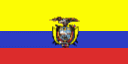 Voters in Ecuador go to the polls today to elect a constituent assembly that will draft a new constitution for the South American nation. Voters in Ecuador go to the polls today to elect a constituent assembly that will draft a new constitution for the South American nation.
The constituent assembly will be composed of 130 members: 100 from the country's twenty-two provinces, 24 from a national list and six chosen by Ecuadorians residing abroad. Provincial and national list seats will be distributed by the largest remainder method of proportional representation. However, in provincial constituencies with two seats, the second largest ticket will be entitled to one mandate if it obtains at least twenty-five percent of the vote. Meanwhile, the six assembly members representing Ecuadorians abroad will be elected in three constituencies - the U.S. and Canada, Europe and Latin America - by simple majority voting.
Political parties and citizen movements submit lists of candidates, and each elector will have a number of votes equal to the number of representatives to be elected. Electors may choose a single list, and in this manner vote for all its candidates, or they may choose candidates from different lists. Seats won by lists will be assigned to the candidates with the largest number of votes within each list. Voting is compulsory, except for electors who are illiterate, handicapped, over the age of 65 or residing abroad.
Ecuador has suffered from political instability in recent times, and the country has had eight presidents over the past eleven years. In the 2006 general election, 44-year old economist Rafael Correa was elected president. Correa, who considers himself a left-wing Christian, has clashed with Congress and wants to implement sweeping institutional changes. In a referendum held last April 15, voters overwhelmingly approved his proposal to call a constituent assembly by 5,354,595 votes in favor (81.7%) to 814,323 against (12.4%), on a 71.6% turnout.
A total of 3,229 candidates are running in the election in 26 national lists, 428 provincial lists, and 44 expatriate lists. Nonetheless, it is expected that the ruling party - the PAIS Alliance (Proud and Sovereign Fatherland) - will obtain the largest the number of seats in the assembly, and possibly an absolute majority.
Ecuador's Supreme Court of Elections website will have live, Spanish-language results of today's election.
|
posted by Manuel Álvarez-Rivera : 09/30/2007 09:39 | permanent link |
|
Ecuador celebra elecciones para una Asamblea Constituyente
|
(This posting is also available in English.)
Los votantes en Ecuador acuden a las urnas hoy para elegir una Asamblea Constituyente que redactará una nueva constitución para la nación sudamericana.
La Asamblea Constituyente se compondrá de 130 miembros: 100 de las veintidós provincias del país, 24 de una lista nacional y seis escogidos por los ecuatorianos residentes en el extranjero. Los escaños provinciales y de la lista nacional se repartirán por el método del resto mayor de representación proporcional. Sin embargo, en las circunscripciones provinciales de dos escaños, le corresponderá un mandato a la candidatura que quede en segundo lugar si la misma consigue por lo menos el veinticinco porciento de los votos. Entre tanto, los seis miembros de la Asamblea que representarán a los ecuatorianos en el extranjero serán electos en tres circunscripciones - EE.UU. y Canadá, Europa y América Latina - por mayoría simple.
Los partidos políticos y los movimientos ciudadanos presentan listas de candidatos, y cada elector contará con un número de votos igual al número de representantes a elegirse. Los electores pueden escoger una sola lista, y de esta manera votar por todos los candidatos en la misma, o pueden escoger a candidatos de diferentes listas. Los escaños que obtengan las listas se le asignarán a los candidatos con mayor número de votos dentro de cada lista. El voto es compulsorio, salvo para los electores analfabetos, discapacitados, mayores de 65 años o residentes en el extranjero.
Ecuador ha sufrido de inestabilidad política en épocas recientes, y el país ha tenido ocho presidentes en los pasados once años. En las elecciones generales de 2006, Rafael Correa, un economista de 44 años, resultó electo presidente. Correa, que se considera a sí mismo un cristiano de izquierda, ha tenido enfrentamientos con el Congreso y desea implementar cambios institucionales abarcadores. En un referéndum celebrado el pasado 15 de abril, los votantes aprobaron su propuesta para convocar a una Asamblea Constituyente por 5,354,595 votos a favor (81.7%) frente a 814,323 en contra (12.4%), con una participación electoral del 71.6%.
Un total de 3,229 candidatos concurren a las elecciones en 26 listas nacionales, 428 provinciales y 44 del extranjero. No obstante, se anticipa que el partido oficialista - la Alianza PAIS (Patria Altiva I Soberana) - obtenga el mayor número de escaños, y posiblemente la mayoría absoluta.
La web del Tribunal Supremo Electoral de Ecuador tendrá los resultados en vivo de la elección de hoy.
|
posted by Manuel Álvarez-Rivera : 09/30/2007 09:39 | permanent link |
|
Tue, Sep 18, 2007
|
2007 Hellenic Parliament election results
|
 Elections to the Hellenic Parliament (Vouli) has been updated with nationwide and constituency-level results of last Sunday's legislative election in Greece, as reported by the Ministry of the Interior's National Elections 2007 website. Elections to the Hellenic Parliament (Vouli) has been updated with nationwide and constituency-level results of last Sunday's legislative election in Greece, as reported by the Ministry of the Interior's National Elections 2007 website.
|
posted by Manuel Álvarez-Rivera : 09/18/2007 19:43 | permanent link |
|
Sun, Sep 16, 2007
|
Elections to the Hellenic Parliament (Vouli)
|
Greece holds an early parliamentary election on Sunday, September 16, 2007. Elections to the Hellenic Parliament (Vouli) has an overview of Greece's electoral system, with results of Greek general elections since 1996. Greece's snap parliamentary election of 2007 - trial by (wild) fire?, in Global Economy Matters, has further information on the event, while Edward Hugh puts The Greek Economy Under The Microscope.
Today's election will be held under a new electoral law passed by the outgoing Pan Hellenic Socialist Movement (PASOK) government in early 2004, which provides for a majority bonus of forty seats (out of a total of 300) for the popular vote winner at the nationwide level; the remaining 260 seats (including 12 nationwide seats and 248 multi-member constituency seats) will be initially allocated by the largest remainder (Hare) method of PR. The legal provisions covering the upcoming elections to the Vouli are contained in Presidential Decree 96/2007 (available in Greek here; link to the Ministry of the Interior, Public Administration and Decentralization).
Under the new system - which retains the existing three percent nationwide threshold - parties could win up to 87% of the seats they would receive under full proportionality (260 of 300 mandates being 86.7% of the total number of Vouli seats), as opposed to 70% under the old law. At the same time, the 40-seat majority prize means a single party could win an absolute parliamentary majority with as little as 42% of the nationwide vote.
Although the new electoral law was enacted in 2004 just before the election held that year, it did not come into effect at the time because the parliamentary majority voting in favor of the law did not reach the two-thirds required by the constitution for the immediate application of a new electoral system. Had the new electoral law been in place for the 2004 election and had voters cast their ballots the same way, the distribution of Vouli seats in the election would have been as follows: New Democracy (ND), 164; PASOK, 111; Communist Party of Greece (KKE), 16; and Coalition of the Left, the Movements and the Ecology (SYN), 9. Compared to the actual 2004 election outcome, ND would have lost just one seat but PASOK would have lost six, while KKE would have gained four seats and SYN would have won three additional mandates.
|
posted by Manuel Álvarez-Rivera : 09/16/2007 11:11 | permanent link |
|
Turkey update
|
 Last July 22, the ruling, moderately Islamist Justice and Development Party (AKP) of Prime Minister Recep Tayyip Erdogan won a clear victory in a snap Grand National Assembly election triggered by a political crisis over the proposed election to the presidency of Abdullah Gul - who was finally chosen by the Grand National Assembly as head of state last August. Last July 22, the ruling, moderately Islamist Justice and Development Party (AKP) of Prime Minister Recep Tayyip Erdogan won a clear victory in a snap Grand National Assembly election triggered by a political crisis over the proposed election to the presidency of Abdullah Gul - who was finally chosen by the Grand National Assembly as head of state last August.
One factor that contributed decisively to AKP's electoral triumph was its record of strong, sustained economic growth under Erdogan's tenure, and Edward Hugh takes an in-depth look at Turkey's economy in Turkey, Emerging Markets and the Coming Global Credit Crunch, Turkey, The Anatolian Tiger and Turkey, The Anatolian Tiger II, at Global Economy Matters.
|
posted by Manuel Álvarez-Rivera : 09/16/2007 09:12 | permanent link |
|
Mon, Sep 10, 2007
|
Belgium: three months without government
|
 It's been three months since Belgian voters went to the polls for a federal election in which the Liberal-Socialist coalition government of Prime Minister Guy Verhofstadt lost its absolute majority in the Chamber of Representatives. However, a new government has yet to emerge. It's been three months since Belgian voters went to the polls for a federal election in which the Liberal-Socialist coalition government of Prime Minister Guy Verhofstadt lost its absolute majority in the Chamber of Representatives. However, a new government has yet to emerge.
In the election, the Christian Democratic & Flemish (CD&V) scored major gains and emerged as the largest party in the Chamber, although well short of an absolute majority. As a result, party leader Yves Leterme was nominated to replace Verhofstadt, who resigned after the election. However, last August 23 Leterme gave up after his attempt to form a coalition cabinet stumbled over the issue of further devolution of powers to the Dutch-speaking region of Flanders. Meanwhile, Verhofstadt remains as caretaker head of government.
Federal Elections in Belgium has detailed results of last June 10 election.
|
posted by Manuel Álvarez-Rivera : 09/10/2007 14:04 | permanent link |
|
Sun, Sep 09, 2007
|
Guatemala celebra elecciones generales
|
(This posting is also available in English.)
 La República de Guatemala celebra elecciones generales en el día de hoy, para escoger a un nuevo presidente y a los miembros del Congreso unicameral, así como a los gobiernos municipales. La República de Guatemala celebra elecciones generales en el día de hoy, para escoger a un nuevo presidente y a los miembros del Congreso unicameral, así como a los gobiernos municipales.
El Presidente de la República, quien es electo de forma directa y mediante sufragio universal por un término de cuatro años, es escogido por mayoría absoluta de votos, y no puede ser re-electo. Si ningún candidato alcanza la mayoría absoluta en la primera vuelta, se celebra una segunda vuelta entre los dos candidatos con mayor número de votos, y se considera electo al que obtenga la mayoría de los votos válidos.
El Congreso de la República se compone de 158 diputados electos de manera directa para un término de cuatro años por el método de media mayor de representación proporcional (la regla D'Hondt) en distritos plurinominales - los departamentos de Guatemala, más la Ciudad de Guatemala - y una lista nacional. Un total de 31 diputados se eligen en la lista nacional, mientras que los restantes 127 escaños se reparten entre los distritos en proporción a su población; sin embargo, cada distrito cuenta con al menos un diputado.
Los partidos políticos presentan candidatos o listas de candidatos. Las listas son cerradas, por lo cual los electores no pueden seleccionar candidatos individuales en o alterar el orden de las mismas. Los electores votan por una sola lista, o por un solo candidato en distritos uninominales.
Un total de dieciseis partidos concurren a las elecciones. La web oficial Voto 2007 del Tribunal Supremo Electoral de Guatemala tendrá disponibles los resultados preliminares de las elecciones del hoy, y el blog de Elecciones Guatemala también le está dando seguimiento al proceso.
|
posted by Manuel Álvarez-Rivera : 09/09/2007 09:36 | permanent link |
|
Guatemala holds a general election
|
(Esta entrada está disponible también en español.)
Guatemala holds a general election today to choose a new president and members of the unicameral Congress, as well as municipal governments.
The President of the Republic, directly elected by universal suffrage for a single term of four years, is chosen by an absolute majority of votes and cannot be re-elected. If no candidate attains an absolute majority in the first round of voting, a second round is held between the two candidates with the largest number of votes, and the candidate that obtains a majority of valid votes is deemed elected.
The Congress of the Republic is composed of 158 deputies directly elected for a four-year term of office by the largest average method of proportional representation (the D'Hondt rule) in multi-member districts - the departments of Guatemala, plus Guatemala City - and a nationwide list. A total of 31 deputies are elected in the national list, while the remaining 127 seats are allocated among the districts in proportion to their population; however, each district has at least one deputy.
Political parties submit candidates or lists of candidates. The lists are closed, so electors may not choose individual candidates in or alter the order of such lists. Electors cast a ballot for a single list, or for a single candidate in single-member districts.
A total of sixteen parties are taking part in the elections. The Guatemalan Supreme Court of Elections official Voto 2007 (Vote 2007; in Spanish) website will have preliminary results of today's election, and the Elecciones Guatemala (Elections Guatemala; also in Spanish) blog is also following the process.
|
posted by Manuel Álvarez-Rivera : 09/09/2007 09:36 | permanent link |
|
Tue, Sep 04, 2007
|
Gone with the wind? Jamaica's PNP loses power to JLP in close poll
|
 Jamaica's ruling People's National Party (PNP) appears to have lost power to the opposition Jamaica Labour Party (JLP) in yesterday's parliamentary election - the closest vote in the country's history. Jamaica's ruling People's National Party (PNP) appears to have lost power to the opposition Jamaica Labour Party (JLP) in yesterday's parliamentary election - the closest vote in the country's history.
Preliminary election results have the JLP prevailing by the narrowest of margins, with 31 seats in the House of Representatives to the PNP's 29. The popular vote was almost evenly divided, with the JLP narrowly ahead of the PNP by 405,215 votes (50.1%) to 402,275 (49.8%), according to Jamaica Elections 2007.
Definitive results are expected in two to three days. If these confirm the preliminary figures, JLP leader Bruce Golding will become the next prime minister of Jamaica, bringing eighteen years of PNP rule to a close. In the meantime, incumbent Prime Minister Portia Simpson Miller refuses to concede defeat, citing election irregularities.
One factor that may have played a decisive role in the government's apparent defeat was its perceived slow response to Hurricane Dean, which battered the Caribbean island nation two weeks ago, forcing the postponement of the general election by a week.
Update
The Electoral Office of Jamaica reports the JLP picked up two additional seats in
Monday's vote, for a majority of 33-27 over the PNP, which has conceded defeat in the election.
|
posted by Manuel Álvarez-Rivera : 09/04/2007 07:12 | permanent link |
|
Sun, Sep 02, 2007
|
Jamaica's 2007 Parliamentary Election
|
Jamaica holds a parliamentary election on Monday, September 3, 2007. The vote, originally scheduled for last August 27, was postponed after the country was severely affected two weeks ago by Hurricane Dean, which passed just south of the Caribbean island nation with devastating 145 mph (230 km/h) winds.
In tomorrow's poll, Jamaican voters will be choosing members of the lower chamber of Parliament, the sixty-seat House of Representatives, in single-member constituencies under the first-past-the-post method used for elections to the House of Commons in both the United Kingdom and Canada. Like both of these countries, Jamaica is a constitutional monarchy with Queen Elizabeth II of the U.K. as head of state (represented by a Governor-General) and a parliamentary system of government headed by a prime minister, who is usually the leader of the largest party in the House of Representatives.
Since the introduction of universal suffrage in 1944, Jamaican politics have been dominated by two major parties, the left-of-center People's National Party (PNP) and the somewhat more conservative Jamaica Labour Party (JLP). Both parties have alternated in power since the country won independence from the U.K. in 1962. The JLP held office from 1962 to 1972 and from 1980 to 1989, when the PNP, which ruled Jamaica from 1972 to 1980, was returned to power in a landslide victory under the leadership of former Prime Minister Michael Manley, son of party founder Norman Manley.
After Manley retired from politics in 1992, Percival J. Patterson succeeded him as head of government, leading the PNP to further landslide victories in 1993 and 1997. The PNP scored a fourth consecutive victory in the October 2002 general election, but the outcome was much closer than in the previous three elections, with the PNP winning thirty-four seats to the JLP's twenty-six. The popular vote was even closer: the PNP polled 396,590 votes (52.1%) and the JLP 360,718 (47.4%), while independent and minor-party candidates received 4,057 votes (0.5%).
In 2006, Prime Minister Patterson stepped down from office; Portia Simpson Miller succeeded Patterson as both party leader and head of government, becoming Jamaica's first-ever female premier.
Update
Live election results are now available on Jamaica Elections 2007.
|
posted by Manuel Álvarez-Rivera : 09/02/2007 10:42 | permanent link |
|
|