Mon, Oct 30, 2006
|
Brazil 2006 Presidential Runoff Results and Map
|
(Esta entrada está disponible también en español.)
 Complete, national- and state-level results of Brazil's 2006 presidential runoff, as well as an election map are now available in Federal Elections in Brazil. Complete, national- and state-level results of Brazil's 2006 presidential runoff, as well as an election map are now available in Federal Elections in Brazil.
|
posted by Manuel Álvarez-Rivera : 10/30/2006 15:13 | permanent link |
|
Resultados y Mapa de Segunda Vuelta Presidencial en Brasil 2006
|
(This posting is also available in English.)
Los resultados completos a nivel nacional y de estado de la segunda vuelta presidencial en Brasil de 2006, así como un mapa electoral ya están disponibles en Elecciones Federales en Brasil.
|
posted by Manuel Álvarez-Rivera : 10/30/2006 15:13 | permanent link |
|
Wed, Oct 11, 2006
|
Elections in Catalonia 2006: Attempted assault on PP leaders
|
(Esta entrada está disponible también en español.)
  The Spanish press reports that yesterday a group of forty to fifty pro-independence demonstrators in Martorell, Barcelona province attempted to assault the leader of the Popular Party (PP) in Catalonia, Josep Piqué, and the party's Secretary-General, Ángel Acebes, who were about to address a local political rally. Neither of them were hurt. The Spanish press reports that yesterday a group of forty to fifty pro-independence demonstrators in Martorell, Barcelona province attempted to assault the leader of the Popular Party (PP) in Catalonia, Josep Piqué, and the party's Secretary-General, Ángel Acebes, who were about to address a local political rally. Neither of them were hurt.
The incident has been roundly condemned by the Catalan government and Parliament, as well as by all major party leaders and prominent political figures such as Spanish Deputy Prime Minister María Teresa Fernández de la Vega, and European Parliament President Josep Borrell.
It was subsequently found out that one of the participants in the demonstration was Jordi López Forn, First Secretary of the Catalan Socialists Youth in Martorell. López Forn has been expelled from the Socialist Party (PSC).
PP leaders faced similar incidents during the campaign for the referendum on Catalonia's new statute of autonomy, held in June of this year. The party was opposed to the measure, which according to them jeopardizes Spain's unity.
|
posted by Manuel Álvarez-Rivera : 10/11/2006 14:29 | permanent link |
|
Elecciones en Cataluña 2006: Intento de agresión a líderes del PP
|
(This posting is also available in English.)
La prensa de España informa que en el día de ayer un grupo de entre cuarenta y cincuenta manifestantes independentistas en Martorell, provincia de Barcelona, intentó agredir al líder del Partido Popular (PP) en Cataluña, Josep Piqué, y al secretario general del partido, Ángel Acebes, quienes se dirigían a un mitin político en la localidad. Ninguno de los dos resultó herido.
El incidente ha sido condenado rotundamente por el gobierno y el Parlamento de Cataluña, así como por los líderes de todos los partidos principales y figuras políticas prominentes tales como la vicepresidenta primera del Gobierno, María Teresa Fernández de la Vega, y el presidente del Parlamento Europeo, Josep Borrell.
Se supo posteriormente que uno de los participantes en la demostración fue Jordi López Forn, primer secretario de las Juventudes Socialistas de Cataluña en Martorell. López Forn ha sido expulsado del Partido Socialista (PSC).
Los líderes del PP se enfrentaron a incidentes parecidos durante la campaña del referéndum sobre el nuevo estatuto de autonomía de Cataluña, celebrado el pasado mes de junio. El partido se opuso a la medida, que según ellos pone en peligro la unidad de España.
|
posted by Manuel Álvarez-Rivera : 10/11/2006 14:29 | permanent link |
|
Elections to the Catalan Parliament
|
(Esta entrada está disponible también en español.)
The Autonomous Community of Catalonia, located in northeastern Spain, holds an early parliamentary election on Wednesday, November 1st, 2006. The results of autonomic elections held in Catalonia from 1980 to 2003, and an overview of the Catalan proportional representation electoral system are now available in Elections to the Catalan Parliament.
|
posted by Manuel Álvarez-Rivera : 10/11/2006 11:53 | permanent link |
|
Elecciones al Parlamento de Cataluña
|
(This posting is also available in English.)
La Comunidad Autónoma de Cataluña, situada en el noreste de España, celebra elecciones parlamentarias anticipadas el miércoles, 1ro de noviembre de 2006. Los resultados de las elecciones autonómicas celebradas en Cataluña de 1980 a 2003, y una breve exposición del sistema electoral catalán de representación proporcional están ahora disponibles en Elecciones al Parlamento de Cataluña.
|
posted by Manuel Álvarez-Rivera : 10/11/2006 11:53 | permanent link |
|
Tue, Oct 10, 2006
|
Austria 2006 General Election Preliminary Results Update
|
(Esta entrada está disponible también en español.)
 Preliminary national- and state-level results of Austria's 2006 general election, updated with the inclusion of absentee ballots, are now available in Federal Elections in Austria - Elections to the Nationalrat (National Council). Preliminary national- and state-level results of Austria's 2006 general election, updated with the inclusion of absentee ballots, are now available in Federal Elections in Austria - Elections to the Nationalrat (National Council).
|
posted by Manuel Álvarez-Rivera : 10/10/2006 09:20 | permanent link |
|
Actualización de Resultados Preliminares de Elecciones Generales en Austria 2006
|
(This posting is also available in English.)
Los resultados preliminares a nivel nacional y de estado de las elecciones generales en Austria de 2006, actualizados al 9 de octubre de 2006 con la inclusión del voto ausente, ya están disponibles en inglés en Federal Elections in Austria - Elections to the Nationalrat (National Council).
|
posted by Manuel Álvarez-Rivera : 10/10/2006 09:20 | permanent link |
|
Sun, Oct 08, 2006
|
Latvia 2006 Saeima Election Preliminary Results
|
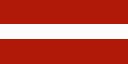 The Central Election Commission of Latvia's 9th Saeima Election website reports final preliminary results of yesterday's vote were as follows: The Central Election Commission of Latvia's 9th Saeima Election website reports final preliminary results of yesterday's vote were as follows:
People's Party - 176,935 votes (19.5%), 23 seats
Union of Greens and Farmers - 151,531 votes (16.7%), 18 seats
New Era - 148,739 votes (16.4%), 18 seats
Harmony Center - 130,946 votes (14.4%), 17 seats
First Party of Latvia & Latvia's Way - 77,957 votes (8.6%), 10 seats
For Fatherland and Freedom - 63,081 votes (6.9%), 8 seats
For Human Rights in a United Latvia - 54,666 votes (6.0%), 6 seats
Latvian Social Democratic Workers' Party - 31,746 votes (3.5%), no seats
Others - 66,968 votes (7.4%), no seats
The total number of votes cast for party lists was 902,569, while the total number of valid ballot envelopes was 907,822. As set forth by Article 38 of the Saeima election law, the number of valid ballot envelopes shall be regarded as the total number of votes cast (the total number of voters taking part in the election).
Voter turnout stood at 62.3%, sharply down from 71.5% in the 2002 Saeima election.
|
posted by Manuel Álvarez-Rivera : 10/08/2006 09:23 | permanent link |
|
Fri, Oct 06, 2006
|
2006 Parliamentary Elections in Latvia
|
Voters in the Republic of Latvia head to the polls on Saturday, October 7, 2006, to choose members of the national unicameral legislature, the Saeima.
The elections for the 9th Saeima will be Latvia's fifth parliamentary poll since the country regained its independence in 1991 - along with neighboring Estonia and Lithuania - after fifty-one years of annexation by the Soviet Union.
Legislative mandates in the 100-seat Saeima, which is elected by universal suffrage for a four-year term of office, are allocated in five multi-member constituencies by the pure Sainte-Laguë method of proportional representation, among lists polling at least five percent of the nationwide vote. Voters may indicate a preference for candidates within a list, or cross out the name of a candidate - the latter practice a holdover from the Soviet era.
The five percent barrier notwithstanding, Latvia's party system has been characterized by a very high degree of political fragmentation. Since 1993 no party has held an absolute majority of Saeima seats, nor for that matter come even close to attaining one. As a result, Latvia has been ruled by a succession of short-lived coalition governments: since independence in 1991, Latvia has had a dozen cabinets, lasting on average little more than a year in office, with the longest-lived holding power for two-and-a-half years.
Cabinet instability is hardly new to Latvia: during the country's first period of independence between the two world wars, there were eighteen governments from 1918 to 1934, which on average lasted less than a year in office. This state of affairs came to an end in 1934, when Kārlis Ulmanis assumed dictatorial powers, ruling the country until it was occupied by the Soviet Union in 1940.
However, the election in 1999 (by the Saeima) of Dr. Vaira Vīķe-Freiberga as Latvia's first-ever female president has brought the country a measure of stability. President Vīķe-Freiberga - who was born in Latvia but grew up in exile and eventually became a psychology professor at Canada's French-speaking University of Montreal - emerged as a widely respected figure, and was re-elected to office in 2003.
During the long Soviet occupation, Latvians came close to becoming a minority in their own country: by 1989, they made up just 52% of Latvia's population, while Russians constituted the second largest ethnic group at 34%. However, since independence the proportion of Latvians has been gradually rising - by 2005 it stood at 59% - while the Russian population has declined to less than 29% (and in the process the country's overall population has dropped by more than ten percent). Still, one of the major problems confronting Latvia is the integration of what remains a sizable number of Russian speakers, many of whom lack Latvian citizenship and therefore can't vote in elections. This problem also has a foreign policy dimension: Russia routinely accuses Latvia of discriminating against ethnic Russians, and relations between the two countries remain tense.
Given its poor relations with Russia - not to mention the traumatic memories of the 1940-91 annexation to the U.S.S.R. - it's hardly surprising that Latvia eagerly pursued membership in the European Union (EU) as well as the North Atlantic Treaty Organization (NATO), securing both in 2004. However, the EU accession referendum held the preceding year highlighted differences between the Latvian- and Russian-speaking communities, as results suggested ethnic Latvians voted overwhelmingly in favor of EU membership, while ethnic Russians entitled to vote were just as staunchly opposed to it.
In fact, Russian speakers who can vote usually line up behind left-wing parties advocating better relations with Moscow. However, since the first post-independence parliamentary election in 1993, right-of-center parties have usually held a majority of seats in the Saeima, although the party system has experienced major changes in every election.
In the 2002 Saeima elections, the right-of-center Latvia's Way, which had been up to that point one of the country's major parties - as well as a coalition partner in every government since 1993 - fell just below the five percent threshold and lost its parliamentary representation; the left-wing Social Democrats were wiped out as well. New Era, a center-right party led by Einars Repše emerged as the largest group, ahead of For Human Rights in a United Latvia, a coalition of several left-wing parties which polled strongly among Russian speakers; the right-of-center People's Party - previously the largest party - finished a close third, followed by two new center-right groups, the Union of Greens and Farmers and the First Party of Latvia.
After the election, Repše formed a four-party coalition government, but he only lasted just over a year in office. Since late 2004, Latvia is ruled by a center-right minority administration headed by Aigars Kalvītis of the People's Party.
|
posted by Manuel Álvarez-Rivera : 10/06/2006 17:08 | permanent link |
|
Wed, Oct 04, 2006
|
Brazil 2006 Legislative Election Results
|
(Esta entrada está disponible también en español.)
Federal Elections in Brazil now has complete, national- and state-level 2006 general election results for the Senate and the Chamber of Deputies.
A total of twenty-one parties will be represented in the Chamber of Deputies elected last Sunday.
|
posted by Manuel Álvarez-Rivera : 10/04/2006 08:27 | permanent link |
|
Resultados de Elecciones Legislativas en Brasil 2006
|
(This posting is also available in English.)
Elecciones Federales en Brasil tiene ya disponibles los resultados completos a nivel nacional y de estado de las elecciones generales de 2006 para el Senado Federal y la Cámara de Diputados.
Un total de veintiún partidos estarán representados en la Cámara de Diputados electa el pasado domingo.
|
posted by Manuel Álvarez-Rivera : 10/04/2006 08:27 | permanent link |
|
Tue, Oct 03, 2006
|
Mapa de Elecciones Presidenciales en Brasil 2006
|
(This posting is also available in English.)
Un mapa de las elecciones presidenciales de 2006 está ahora disponible en Elecciones Federales en Brasil.
|
posted by Manuel Álvarez-Rivera : 10/03/2006 00:06 | permanent link |
|
Brazil 2006 Presidential Election Map
|
(Esta entrada está disponible también en español.)
A 2006 presidential election map is now available in Federal Elections in Brazil.
|
posted by Manuel Álvarez-Rivera : 10/03/2006 00:06 | permanent link |
|
Mon, Oct 02, 2006
|
Federal Elections in Austria 2006: Carinthia Rescues Jörg Haider's BZÖ
|
Contrary to widespread expectations, Jörg Haider's right-wing Alliance for the Future of Austria (BZÖ) narrowly cleared the four percent threshold in last Sunday's parliamentary election in Austria, which entitled his party to eight mandates in the 183-seat National Council.
However, definitive provisional returns show the Alliance had a strong showing in just a single state: Carinthia, presently ruled by none other than Haider himself. The BZÖ finished second there (the Social Democrats carried the state) and polled an impressive 25.4% of the vote, displacing the ruling Austrian People's Party (ÖVP) to an ignominious third place.
Haider focused on his own state in an attempt to bypass the four percent barrier by winning a direct mandate in one of the state's regional multi-member constituencies. As it was, he narrowly missed this objective: the Alliance failed to reach the statewide Hare quota of 24,074 votes in every one of Carinthia's four constituencies, although in regional district 2D (Carinthia East) the BZÖ fell short by a mere 128 votes. However, in the end this became a moot point, as the Alliance vote in Carinthia lifted the party's nationwide share of the vote to 4.2% - just above the four percent election threshold.
That said, in the rest of Austria the BZÖ fared disastrously, polling just 2.6% of the vote. In fact, Haider's party trailed independent MEP Hans-Peter Martin's list outside Carinthia.
|
posted by Manuel Álvarez-Rivera : 10/02/2006 19:41 | permanent link |
|
Resultados de Elecciones Presidenciales en Brasil 2006
|
(This posting is also available in English.)
Los resultados completos a nivel nacional y de estado de las elecciones presidenciales en Brasil de 2006 ya están disponibles en Elecciones Federales en Brasil.
En la elección, el Presidente Lula (PT) quedó en primer lugar, pero sin mayoría absoluta de los votos válidamente emitidos. Por lo tanto, el domingo, 29 de octubre de 2006 se llevará a cabo una segunda vuelta entre Lula y Geraldo Alckmin (PSDB), quien terminara en segundo puesto en la votación del domingo.
|
posted by Manuel Álvarez-Rivera : 10/02/2006 16:34 | permanent link |
|
Brazil 2006 Presidential Election Results
|
(Esta entrada está disponible también en español.)
Complete, national- and state-level results of Brazil's 2006 presidential election are now available in Federal Elections in Brazil.
In the election, President Lula (PT) came in first place, but short of an absolute majority of valid votes. Therefore, on Sunday, October 29, 2006 a runoff election will be held between Lula and Geraldo Alckmin (PSDB), who finished second in Sunday's vote.
|
posted by Manuel Álvarez-Rivera : 10/02/2006 16:34 | permanent link |
|
Sun, Oct 01, 2006
|
Austria General Election 2006 Preliminary Results
|
(Esta entrada está disponible también en español.)
Complete, preliminary national- and state-level results of Austria's 2006 general election are now available in Federal Elections in Austria - Elections to the Nationalrat (National Council).
|
posted by Manuel Álvarez-Rivera : 10/01/2006 15:34 | permanent link |
|
Resultados Preliminares de Elecciones Generales en Austria 2006
|
(This posting is also available in English.)
Los resultados preliminares completos a nivel nacional y de estado de las elecciones generales en Austria de 2006 ya están disponibles en inglés en Federal Elections in Austria - Elections to the Nationalrat (National Council).
|
posted by Manuel Álvarez-Rivera : 10/01/2006 15:34 | permanent link |
|